
How Much Does a Concrete Slab Cost in 2026?
On average, pouring a residential concrete slab costs between $7.00 and $13.00 per square foot for professional installation. For a standard 4-inch thick slab measuring 400 square feet (20×20 ft), the total installed cost typically ranges from $2,810 to $5,060. Small slabs cost more per square foot because delivery, forms and setup are spread over less area (a 10×10 ft slab runs $840 to $1,430). If you choose to self-perform the work (DIY mode) and purchase only the raw materials, concrete slab costs typically range between $2.50 and $4.50 per square foot.
Material-only cost includes the concrete (ready-mix or bags), form boards, vapor barrier, and rebar ($2.50–$4.50/sq ft). Installed cost includes form layout, reinforcement tying, screeding, bull floating, power troweling, saw-cut control joints, and curing ($7.00–$13.00/sq ft). Site excavation, grading and a compacted gravel base add about $1.40–$3.30/sq ft when the site needs them.
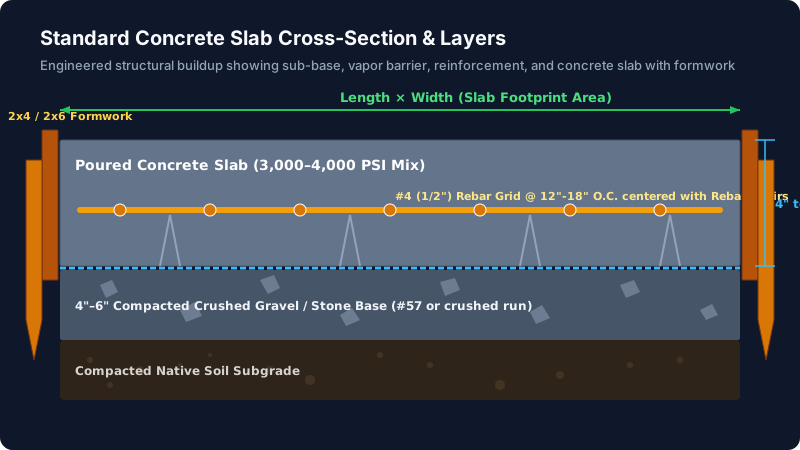
What Goes Into a Concrete Slab Cost? (Comprehensive Line Items)
A realistic concrete slab estimate requires breaking down all physical components and labor stages. Below is a detailed inspection of each scope element:
1. Concrete Material (Ready-Mix or Bags)
Ready-mix concrete delivered by a transit truck averages $135 to $180 per cubic yard (3,000 to 4,000 PSI standard compressive mix). Bagged concrete mix (such as Quikrete or Sakrete) costs approximately $6.00 to $8.00 per 80-lb bag. Ready-mix is usually more economical above about 1.5 cubic yards, even with a short-load fee, while bagged concrete is ideal for small pads or remote locations where ready-mix trucks cannot access.
2. Site Excavation & Grading
Preparing the ground involves removing grass, topsoil, and organic matter to a depth of 4 to 8 inches. Excavation costs typically run $1.00 to $2.50 per square foot, depending on root systems, slope, and soil density.
3. Compacted Gravel Sub-Base
A sturdy 4-inch base of crushed stone (such as #57 stone or crushed aggregate base) distributes vehicle loads, prevents frost heaving, and allows water drainage. Crushed gravel costs approximately $35 to $55 per cubic yard (or $25 to $40 per ton).
4. Perimeter Formwork Lumber
Wood formwork built with 2×4 or 2×6 dimensional lumber, wood stakes, and duplex nails holds the wet concrete in place during placement and curing. Form lumber and staking materials generally cost $1.50 to $3.00 per linear foot of slab perimeter.
5. Steel Reinforcement (Rebar vs. Wire Mesh)
Reinforcement absorbs tensile stresses and controls drying shrinkage cracking. Standard #4 (1/2") steel rebar tied on 12-inch to 18-inch grid centers costs approximately $1.00 to $1.75 per square foot including rebar support chairs. Welded wire mesh (6×6 W1.4/W2.9) costs approximately $0.40 to $0.70 per square foot.
6. Vapor Barrier Moisture Retarder
A heavy-duty 10-mil to 15-mil polyethylene vapor barrier placed beneath interior garage or enclosed shed slabs prevents ground moisture vapor from migrating through the cured concrete. Vapor barriers cost $0.25 to $0.45 per square foot.
7. Surface Finishing Technique
Finishing determines appearance and slip resistance:
- Broom Finish: Standard textured exterior finish for walkways and driveways (included in standard labor or +$0.50–$0.80/sq ft).
- Smooth Hard Trowel: Polished interior finish for workshops and garages (+$1.00–$1.50/sq ft).
- Exposed Aggregate: Decorative stone surface (+$2.50–$4.50/sq ft).
- Stamped & Stained Concrete: Patterned brick/slate textures (+$6.00–$12.00/sq ft).
8. Concrete Finishing Labor
Experienced concrete finishers charge between $3.50 and $7.00 per square foot (about $40 to $70 per finisher-hour, or $120 to $280 per hour for a 3–4 person crew) for setup, pouring, screeding, floating, edging, control joint cutting, and applying curing compound.
9. Delivery Charges & Pump Rental
Transit mixer suppliers often add a short-load fee of $80 to $200 on orders below their minimum, which ranges from 4 to 10 cubic yards and is commonly 5 to 6 cubic yards (fee breakdown). If the concrete truck cannot park within 15 to 20 feet of the forms due to fences, landscaping, or steep terrain, a trailer line pump or boom pump truck must be rented for $600 to $1,200 per pour (line vs. boom pump).
Concrete Slab Cost by Size (Reference Matrix)
Below are typical installed and DIY budget benchmarks across popular residential slab footprint dimensions at a standard 4-inch depth:
| Slab Dimensions | Surface Area | Cubic Yards (4" Thick) | Order Volume (+10% Waste) | 80-lb Bags (+10% Waste) | 60-lb Bags (+10% Waste) | Materials Only (DIY) | Installed Cost |
|---|---|---|---|---|---|---|---|
| 10 × 10 ft | 100 sq. ft. | 1.23 yd³ | 1.36 yd³ | 62 bags | 82 bags | $410 – $570 | $840 – $1,430 |
| 10 × 20 ft | 200 sq. ft. | 2.47 yd³ | 2.72 yd³ | 123 bags | 163 bags | $660 – $980 | $1,510 – $2,660 |
| 12 × 12 ft | 144 sq. ft. | 1.78 yd³ | 1.96 yd³ | 88 bags | 118 bags | $520 – $750 | $1,130 – $1,970 |
| 16 × 24 ft | 384 sq. ft. | 4.74 yd³ | 5.21 yd³ | 235 bags | 313 bags | $1,080 – $1,690 | $2,710 – $4,880 |
| 20 × 20 ft | 400 sq. ft. | 4.94 yd³ | 5.43 yd³ | 245 bags | 326 bags | $1,110 – $1,750 | $2,810 – $5,060 |
| 24 × 24 ft (2-Car Garage) | 576 sq. ft. | 7.11 yd³ | 7.82 yd³ | 352 bags | 470 bags | $1,500 – $2,430 | $3,950 – $7,170 |
| 30 × 40 ft (Shop/Barn) | 1,200 sq. ft. | 14.81 yd³ | 16.30 yd³ | 734 bags | 978 bags | $2,870 – $4,790 | $7,970 – $14,620 |
Concrete Slab Thickness Guide: 4" vs. 5" vs. 6"
Choosing the correct thickness is critical for structural load capacity and longevity. The chart below illustrates standard depth ratings:
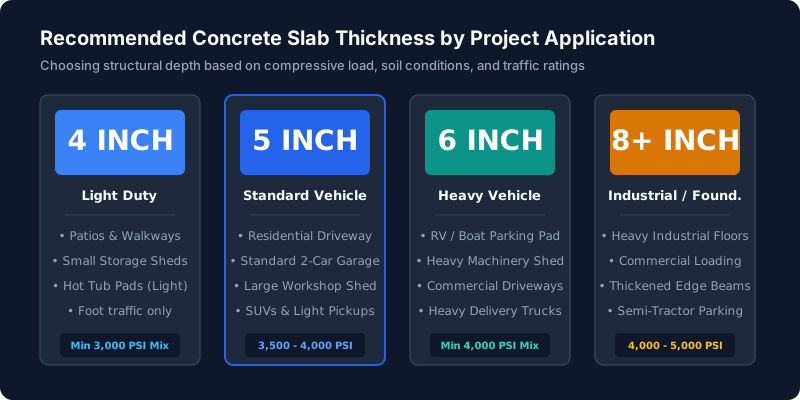
- 4-Inch Slab: Best for foot-traffic applications, including patios, sidewalks, trash bin pads, and light utility sheds (min 3,000 PSI).
- 5-Inch Slab: Ideal for standard residential driveways, 2-car garages, and parking pads supporting passenger sedans and light pickup trucks (3,500–4,000 PSI, air-entrained in freeze-thaw areas).
- 6-Inch Slab: Recommended for RV parking pads, heavy-duty workshops, commercial loading docks, and heavy multi-axle vehicle storage (4,000+ PSI with #4 rebar grid).
How to Calculate Concrete for a Slab (Mathematical Formulas)
Calculating concrete volume is straightforward when using consistent units. All volume calculations follow three fundamental steps:
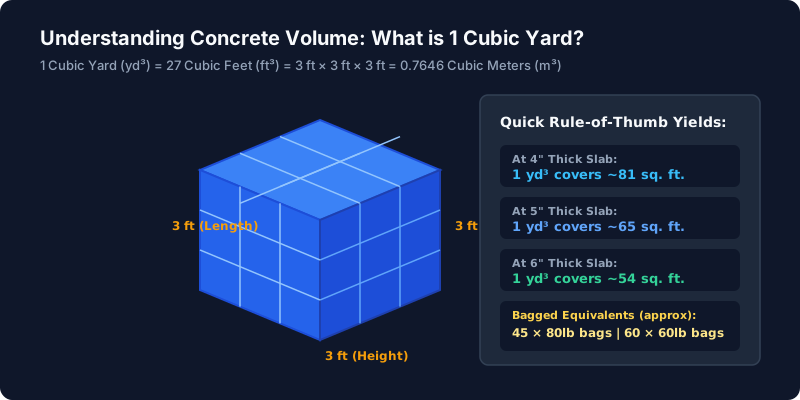
Practical Example: Calculating a 20×20 Concrete Slab at 4 Inches
- Calculate Surface Area: 20 ft × 20 ft = 400 sq. ft.
- Convert Thickness to Feet: 4 inches ÷ 12 = 0.3333 ft.
- Calculate Net Volume: 400 sq. ft. × 0.3333 ft = 133.33 cubic feet.
- Convert to Cubic Yards: 133.33 cu. ft. ÷ 27 = 4.94 cubic yards.
- Apply 10% Waste Factor: 4.94 × 1.10 = 5.43 cubic yards (Order 5.5 yards from your ready-mix supplier).
Ready-Mix vs. Bagged Concrete: Which is Better for Your Slab?
| Factor | Ready-Mix Concrete (Truck Delivery) | Bagged Concrete Mix (Pre-Mixed Bags) |
|---|---|---|
| Best For | Slabs > 1.5 cubic yards (Patios, Driveways, Garages) | Small repairs, post holes, pads < 1.0 cu yd (4x4, 6x6) |
| Cost Comparison | $135–$180/yd³ + delivery (~$5.00–$6.67/cu ft before fees) | $6.50/80-lb bag = $10.83/cu ft (~$293/cu yd) |
| Mixing Effort | Discharged from truck chute in 15–30 minutes | Requires manual shovel mixing or drum mixer for hours |
| Strength Consistency | Engineered batch plant control (exact water/cement ratio) | Varies per batch based on hand-measured water additions |
| Cold Joint Risk | Zero (continuous monolithic pour) | High (if mixing cannot keep up with initial set) |
Concrete Slab Reinforcement: Rebar Grid vs. Welded Wire Mesh
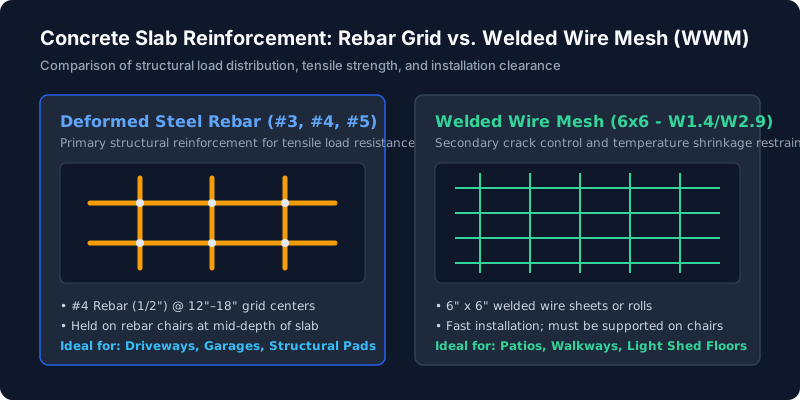
Concrete exhibits exceptional compressive strength (resisting downward crushing), but possesses low tensile strength (susceptible to cracking when pulled or bent). Steel reinforcement provides necessary tensile resistance:
- #4 (1/2") Steel Rebar Grid: Essential for vehicle loads (driveways, garages, equipment pads). Tied on 12" to 18" grid squares and held at mid-depth using concrete or plastic rebar chairs.
- Welded Wire Mesh (6×6 W1.4/W2.9): Adequate for light foot-traffic slabs (patios, walkways, shed floors). Controls drying shrinkage micro-cracking.
Factors That Increase Concrete Slab Costs
When requesting contractor quotes, several jobsite variables can increase unit prices:
- Restricted Site Access: If concrete trucks cannot back up directly to the slab forms, wheelbarrowing concrete or hiring a pump truck ($600–$1,200) increases labor and equipment expense.
- Sloped or Uneven Ground: Sloped terrain requires additional excavation, retaining walls, or thicker edge forms.
- Tree Root Removal & Rock Excavation: Rocky soil or large root systems require mini-excavator equipment or jackhammers.
- Permits & Inspections: Municipal flatwork or building permits for small residential slabs commonly range from $50 to $350 depending on local jurisdiction.
Concrete Slab Cost by PSI Strength (3000 vs. 3500 vs. 4000 vs. 4500 PSI)
PSI is the compressive strength the mix reaches after 28 days of curing. Stronger mixes use more cement per yard, so each 500-PSI step usually adds about $4 to $10 per cubic yard to the ready-mix price. Air entrainment, fiber, or accelerators are billed on top of that.
| Mix Strength | Typical Price per yd³ | Typical Residential Use | Extra Cost on a 20×20 ft, 4" Slab (5.43 yd³) |
|---|---|---|---|
| 2,500 PSI | $131 – $150 | Footings and interior slabs not exposed to weather | −$20 to −$55 |
| 3,000 PSI | $135 – $160 | Patios, walkways, shed floors in mild climates | Baseline |
| 3,500 PSI | $139 – $170 | Garage floors, driveways, porches and steps in freeze-thaw areas | +$20 to +$55 |
| 4,000 PSI | $143 – $180 | Driveways that see de-icing salt, RV and truck pads | +$45 to +$110 |
| 4,500+ PSI | $147 – $190 | Heavy equipment, shop floors with forklifts, commercial aprons | +$65 to +$165 |
The International Residential Code (Table R402.2) sets the minimums: 2,500 PSI where concrete is protected from weather, 3,000 PSI for exposed walls and foundations, and 3,500 PSI, air-entrained, for garage floors, porches and steps in severe-weathering regions. On the 20×20 ft slab above, moving from 3,000 to 4,000 PSI adds roughly $45 to $110, which is small next to the cost of replacing a scaling or cracked driveway. Thickness, base compaction and joint spacing affect durability far more than going beyond 4,000 PSI on a home slab.
Concrete Pumping Cost: Line Pump vs. Boom Pump
A ready-mix truck's chute reaches only about 15 to 20 feet past where the truck can park. When the forms sit behind a house, a fence or soft lawn, you either wheelbarrow the concrete or pay for a pump. Most residential pours land in the $600 to $1,200 range, and the type of pump decides where you fall.
| Factor | Line (Trailer) Pump | Boom Pump Truck |
|---|---|---|
| Typical Rate | $100 – $175 per hour, 2–4 hour minimum | $150 – $350 per hour, 3–4 hour minimum |
| Typical Residential Pour | $400 – $800 | $900 – $1,800+ |
| Reach | Hose laid on the ground, commonly 150–300 ft from the truck | Boom arm reaches roughly 75–200 ft over roofs and fences |
| Output | Slower; fine for patios, backyard slabs and footings | Fast; suits large garage slabs, foundations and second-floor pours |
| Mix Requirement | Often needs a pump mix with 3/8" pea gravel (about $5–$10 more per yd³) | Usually pumps standard 3/4" aggregate mixes |
Because of the hourly minimum, a pump costs about the same for 3 yards as for 10. On a small slab, compare the pump quote with two or three helpers and wheelbarrows: a 10×10 ft slab (1.36 yd³) is only about a dozen wheelbarrow trips, while a 24×24 ft garage slab is closer to 70. Add the pump to your estimate with the Concrete Pump Truck option in the calculator above.
Ready-Mix Short Load Fee Breakdown
A transit mixer carries 8 to 10 cubic yards. When you order less than the plant's minimum, the supplier adds a short-load fee to cover the driver and truck time. Minimums and fees vary by plant, so always ask for both when you call for a price.
- Flat fee: commonly $80 to $200 per load on orders below the minimum.
- Per-yard fee: some plants charge $30 to $45 for each yard you are short of the minimum.
- Where the minimum sits: most suppliers set it between 4 and 10 yd³, and many residential suppliers use 5 to 6 yd³.
- Other add-ons: fuel or environmental surcharges ($10–$50) and overtime if the truck waits past the free unloading time, usually 5–8 minutes per yard.
Worked example (10×10 ft, 4" slab): the slab needs 1.36 yd³ with 10% waste. Plants sell in quarter- or half-yard steps, so you order 1.5 yd³ at $150 = $225, plus a typical $120 short-load fee, for about $345 delivered. The same slab in bags is 62 × 80-lb bags at $6.50 = $403, plus roughly 2.5 tons of hand mixing. Below about 1 cubic yard bags usually win; above 1.5 yards ready-mix usually wins even with the fee. A short-load fee is also a reason to combine pours, such as a patio and a walkway on the same day.
Monolithic Turn-Down Slab vs. Floating Slab Foundation Cost
A floating slab is a flat slab of uniform thickness that rests on compacted gravel. A monolithic (turn-down) slab is poured in one piece with a thickened edge that acts as its footing, usually 12" wide and 12" to 18" deep, with two continuous #4 bars in the edge. Garages and larger sheds often need the turn-down edge to pass inspection.
| 24×24 ft Garage, 4" Slab | Floating Slab | Monolithic, 12" Edge | Monolithic, 18" Edge |
|---|---|---|---|
| Concrete (with 10% waste) | 7.82 yd³ | 10.32 yd³ | 12.20 yd³ |
| Concrete Cost at $150/yd³ | $1,173 | $1,548 | $1,829 |
| Edge Rebar (2 × #4, 192 lin. ft) | — | $100 – $150 | $100 – $150 |
| Extra Trenching | — | $150 – $400 | $250 – $600 |
| Approximate Added Cost | Baseline | +$625 – $925 | +$1,005 – $1,405 |
The edge volume comes from the footing ring under the slab: (24×24 − 22×22) = 92 sq ft of footprint, deepened 8" (12" edge) or 14" (18" edge) below the 4" slab. Use the concrete footing calculator for other sizes.
When a floating slab is allowed: under IRC R403.1.4.1, a freestanding accessory building of 600 sq ft or less, light-frame construction, with eaves 10 ft or lower does not need frost protection, so a floating slab is usually fine for sheds and small detached garages. Attached garages and anything larger normally need footings at the local frost depth. A 12"–18" turn-down meets that only where frost depth is shallow; in colder areas it needs a deeper frost wall or an insulated frost-protected shallow foundation. Your local building department has the final say.
Concrete Control Joint Spacing, Saw-Cut Timing & Linear Footage
Concrete shrinks as it dries and will crack somewhere. Control joints decide where. The usual rule (ACI 302.1R) is to space joints 2 to 3 times the slab thickness in inches, in feet. Staying near 2 to 2.5 times gives the best crack control, and panels should be close to square, no more than 1.5 times longer than wide.
| Slab Thickness | Joint Spacing (Recommended) | Maximum Spacing | Saw-Cut Depth (¼ of Thickness) |
|---|---|---|---|
| 4 inches | 8 – 10 ft | 12 ft | 1" |
| 5 inches | 10 – 12.5 ft | 15 ft | 1¼" |
| 6 inches | 12 – 15 ft | 15 ft | 1½" |
Saw-cut timing: cut as soon as the surface holds a blade without the edges ravelling, typically 4 to 12 hours after finishing with a conventional wet saw. Hot, windy days shorten that window and cool weather stretches it. Early-entry dry saws can cut 1 to 4 hours after finishing. Waiting until the next day often means the slab has already cracked on its own. Tooled joints made with a groover while the concrete is still plastic avoid the timing problem on small slabs.
Linear footage: for a slab L × W with joint spacing S, the number of joints across the length is the length divided by S, rounded up, minus one; each of those runs the full width, and the same applies the other way.
- 20×20 ft, 4" slab at 10 ft: 1 joint each way = 20 + 20 = 40 linear ft (four 10×10 panels).
- 24×24 ft, 4" slab at 8 ft: 2 joints each way = 48 + 48 = 96 linear ft (nine 8×8 panels).
A walk-behind saw with a diamond blade rents for about $60 to $120 per day. Contractors commonly charge around $1 to $2 per linear foot when saw-cutting is priced separately, though most include it in the finishing labor.