
Concrete vs. Asphalt Driveway: Cost, Lifespan, and Which One Actually Wins
If you’re repaving or pouring a new driveway, this comes down to a genuine trade-off, not an easy winner: asphalt costs less up front and is easier to patch, while concrete costs more initially but lasts roughly twice as long and needs less routine attention. Which one makes sense depends more on your climate, your budget timeline, and how long you plan to stay in the house than on which material is “better” in the abstract.
Upfront Cost: Asphalt Wins, Concrete Wins Over Time
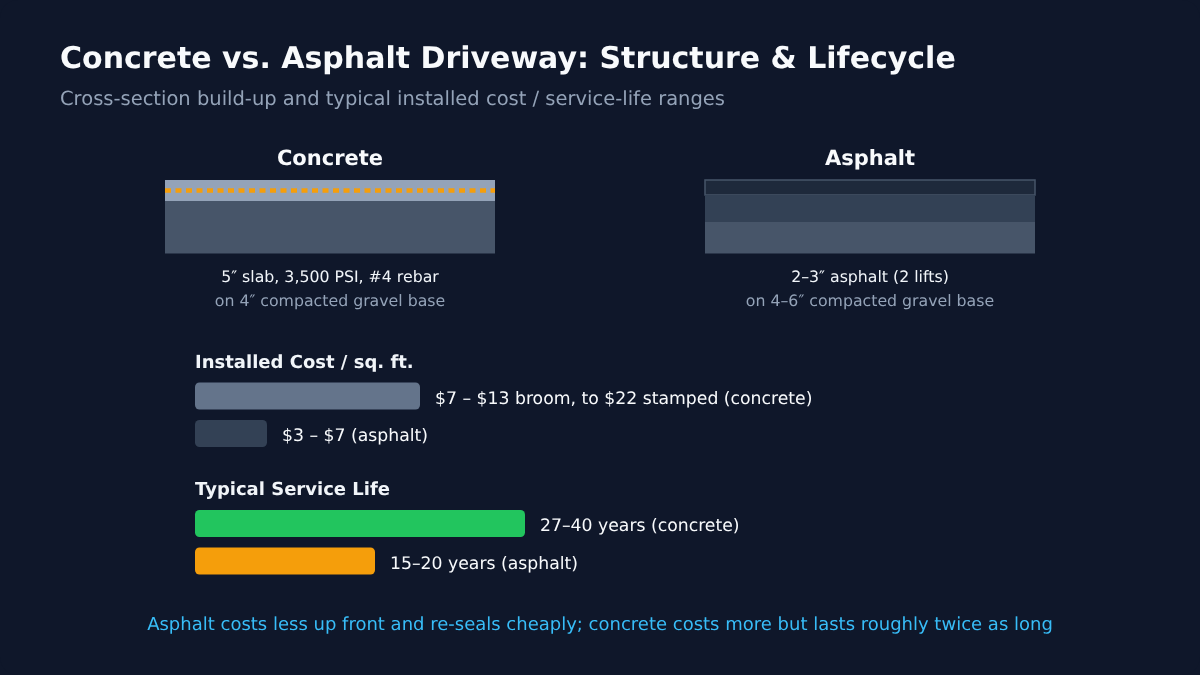
Installed, asphalt driveways typically run about $3 to $7 per square foot, while concrete driveways run about $7 to $13 per square foot for a standard 5-inch broom finish and up to about $22 stamped, largely depending on thickness, reinforcement, and finish. That puts a standard 2-car, 800-square-foot driveway at roughly $2,400 to $5,600 for asphalt versus $5,820 to $10,380 for broom-finished concrete — our own concrete driveway cost guide uses the same $5,820 to $10,380 for the 5-inch, rebar-reinforced slab we recommend for vehicle loads. Get an exact number for your dimensions with the concrete slab cost calculator or the cost per square foot calculator.
Lifespan: Concrete’s Real Advantage
This is where the math shifts in concrete’s favor. Asphalt driveways typically last 15 to 20 years (up to 30 with diligent maintenance), while concrete driveways average around 27.5 years and can reach 30 to 40 years with proper care. Run the numbers over a 30-year ownership horizon and concrete’s higher upfront cost gets diluted across a longer service life, while an asphalt driveway is likely due for a full replacement — not just a reseal — at least once in that window.
Maintenance: Frequent and Cheap vs. Rare and Pricier
Asphalt needs more routine attention: sealcoating every 2 to 3 years (roughly $0.15 to $0.30 per square foot) to protect against UV and water damage, plus minor crack repairs that run about $1 to $3 per linear foot. It’s cheap, DIY-friendly maintenance, but it’s recurring.
Concrete needs very little routine maintenance beyond occasional sealing — see our concrete sealer guide for when that’s actually worth doing — but when concrete does need repair, it’s a bigger job: $3 to $25 per square foot depending on severity, since patch color and texture rarely blend seamlessly with the surrounding slab.
Climate: This Might Be the Deciding Factor
Asphalt has a real practical advantage in cold climates: it flexes slightly, so it tends to handle freeze-thaw cycling and minor ground movement better than rigid concrete, which is prone to cracking under the same stress unless it’s properly air-entrained and control-jointed. Asphalt also doesn’t show deicing salt damage the way concrete surfaces can (salt-induced scaling is a real issue on unsealed or non-air-entrained concrete).
Concrete, on the other hand, handles heat much better. Asphalt can soften and rut under sustained high temperatures and heavy vehicle loads, which is why you’ll rarely see asphalt driveways in the hottest parts of the Southwest, and concrete’s light color also reflects more heat than asphalt’s near-black surface — a real consideration if your driveway sees a lot of summer sun.
Color and Finish Options
Concrete offers more finish flexibility out of the box: standard broom finish, exposed aggregate, stamped patterns, integral color, or acid staining, all of which change the cost per square foot but let you match a driveway’s look to the rest of your property. Asphalt is functionally limited to its standard black finish, though some regions offer colored sealcoating as a cosmetic option. If curb appeal and design flexibility matter to your decision, that’s a real point in concrete’s favor beyond the raw cost-and-lifespan comparison.
Appearance and Resale Value
Concrete generally reads as the more “finished,” higher-end option and tends to be viewed more favorably in resale comparisons, especially with a stamped or broom-finished surface — see our patio finish guide for how those decorative options translate to driveways too. Asphalt’s uniform black surface is often seen as more utilitarian, though it does a good job of hiding oil stains and everyday wear that show up more visibly on light-colored concrete.
Side-by-Side Summary
| Factor | Concrete | Asphalt |
|---|---|---|
| Installed cost | $7–$13/sq ft (broom), to $22 stamped | $3–$7/sq ft |
| Typical lifespan | 27–40+ years | 15–20 (up to 30) years |
| Routine maintenance | Minimal; occasional sealing | Sealcoat every 2–3 years |
| Repair cost | $3–$25/sq ft | $1–$3/linear ft (cracks) |
| Cold-climate flexibility | Rigid — needs joints/air-entrainment | Flexible — handles movement well |
| Hot-climate durability | Excellent | Can soften/rut in extreme heat |
Hybrid and Alternative Options Worth Knowing About
These aren’t the only two choices. Chip seal and gravel driveways cost less than either asphalt or concrete but need more frequent regrading and don’t handle heavy daily traffic as gracefully. Permeable concrete and permeable asphalt/pavers are increasingly common where stormwater runoff regulations apply, trading some upfront cost premium for reduced water pooling and, in some municipalities, stormwater fee credits. Pavers (concrete or clay) cost more than either poured option but offer the easiest individual-unit repair — a single cracked or stained paver can be swapped without touching the rest of the surface, unlike a monolithic concrete or asphalt driveway where any repair affects a larger area.
So Which Should You Choose?
If you’re optimizing for the lowest possible upfront cost, or you live somewhere with brutal freeze-thaw winters and don’t mind resealing every couple of years, asphalt is a reasonable, well-tested choice. If you’re planning to stay in the home for decades, want the lowest lifetime maintenance burden, or live somewhere hot, concrete’s higher installed cost usually pencils out favorably over a 20-to-30-year horizon. Either way, get quotes based on your actual site conditions — soil type, slope, and drainage all affect base preparation cost regardless of which surface material you choose.
Installation Timeline: A Practical Difference Most People Miss
Asphalt has a genuine scheduling advantage: it can typically be driven on within 24 to 72 hours of installation, since it cools and hardens rather than cures chemically the way concrete does. Concrete needs the full curing timeline — light traffic around day 7, full vehicle loads only after 28 days — which matters if you’re replacing your only driveway and don’t have an alternate place to park for a month.
Environmental Considerations
Asphalt is petroleum-based and can be fully recycled at end of life — reclaimed asphalt pavement is one of the most recycled materials in the country by volume, and a torn-out asphalt driveway can go straight into new paving mix. Concrete’s raw materials (aggregate and cement) are also recyclable as crushed base material, but cement production itself is energy-intensive and carries a heavier carbon footprint per ton than asphalt binder. On the other side of the ledger, concrete’s much longer lifespan means fewer total replacement cycles, which narrows or can even reverse the lifecycle environmental gap depending on how you weight upfront production versus long-term durability.
Noise and Comfort
Asphalt’s slightly softer surface tends to be quieter under tire noise and marginally more comfortable to walk or stand on for extended periods — a minor factor for a driveway, but worth knowing if the same decision applies to a basketball court or walking path.
Don’t Forget the Base — It Matters More Than the Surface Material
Whichever surface you choose, a driveway is only as good as what’s underneath it. Both concrete and asphalt driveways rely on a properly compacted gravel base for drainage and load distribution — typically 4 inches under concrete and 4 to 6 inches under asphalt, since asphalt’s more flexible structure needs a bit more support depth to avoid rutting. A driveway that fails prematurely, in either material, traces back to inadequate base preparation far more often than it traces back to a flaw in the surface material itself. Our gravel base calculator and yard prep checklist apply to either surface choice.
Getting an Accurate Quote for Your Specific Driveway
Every number in this article is a national average range — actual pricing depends heavily on your local material costs, site accessibility, soil conditions, and slope. Before committing to either material, get at least two or three contractor quotes for the same design, and use our concrete slab cost calculator to sanity-check a concrete bid against current material and labor assumptions for your exact dimensions.
Frequently Asked Questions
Can you pour asphalt over an old concrete driveway, or vice versa?
Asphalt can sometimes be overlaid on sound concrete with proper prep, but concrete generally should not be poured directly over old asphalt — asphalt continues to shift and soften with temperature, which will crack a rigid concrete slab poured on top of it.
Which one is better for a steep driveway?
Concrete typically wins here since it can be finished with a heavier broom texture or exposed aggregate for better traction, and it doesn’t soften in summer heat the way asphalt can on a slope.
Does a concrete driveway actually need rebar?
For a driveway carrying vehicle loads, yes — a 5-inch slab with reinforcement is the standard recommendation (local codes vary) (see our rebar calculator), which is part of why driveways cost more per square foot than a non-structural patio slab.
Is one material significantly cheaper to remove and replace later?
Asphalt removal is generally cheaper and faster since it can often be milled or ripped up in large sections, while concrete removal usually requires breaking and hauling reinforced slab sections — see our demolition cost calculator for an estimate either way.
Calculate Your Concrete Project Budget
Use our comprehensive concrete slab cost calculator to get a complete line-item breakdown of materials, labor, reinforcement, and base preparation.
Launch Concrete Slab Calculator →