
Concrete Sealers: Do You Need One, and Which Type?
Sealing concrete is one of those maintenance tasks that’s genuinely optional for some slabs and genuinely important for others, and the marketing around it doesn’t always make that distinction clear. The honest answer is: it depends on your climate, how the slab is used, and whether you care more about protection or appearance — and the type of sealer you choose matters just as much as whether you seal at all.
What a Sealer Actually Does
Concrete is naturally porous, which means it absorbs water, and water is the root cause of most of the damage concrete suffers over time: freeze-thaw spalling in cold climates, deicing salt scaling, staining from oil and organic matter, and efflorescence (the white mineral deposits that form as water carries salts to the surface and evaporates). A sealer’s job is to reduce how much water and contaminants penetrate the surface, which directly reduces all of those failure modes.
Two Fundamentally Different Approaches
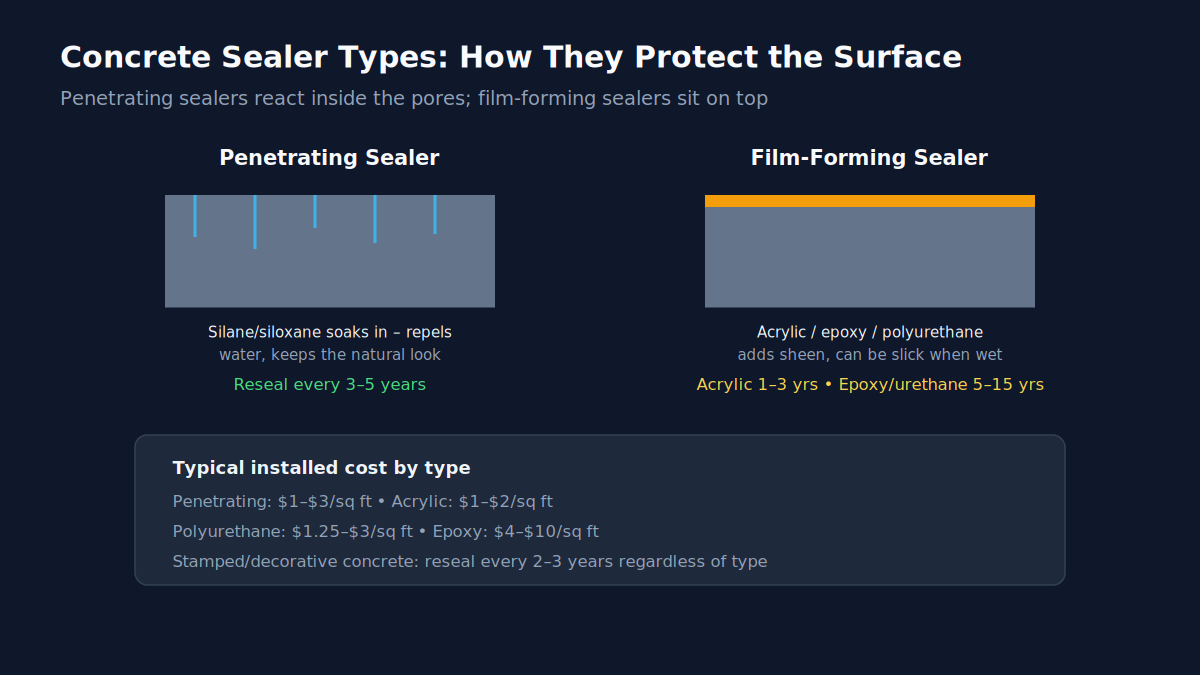
Penetrating sealers (silane, siloxane, or silicate-based) soak into the concrete’s pores and react chemically to repel water from the inside, without leaving a visible film on the surface. They preserve the concrete’s natural look and matte finish, don’t affect slip resistance, and are the standard choice for driveways and exterior slabs where appearance changes and surface slickness are undesirable.
Film-forming sealers (acrylic, epoxy, or polyurethane) create a visible protective layer on top of the concrete. They add sheen — anywhere from a satin to a high-gloss look — and can enhance color, especially on stamped or stained decorative concrete, but they can also make a surface more slippery when wet, which is worth considering for a pool deck or a patio in a rainy climate.
Cost and Reapplication by Type
| Sealer Type | Installed Cost / sq. ft. | Typical Reapplication |
|---|---|---|
| Penetrating (silane/siloxane) | $1.00 – $3.00 | Every 3–5 years |
| Acrylic | $1.00 – $2.00 | Every 1–3 years |
| Polyurethane | $1.25 – $3.00 | Every 5–15 years |
| Epoxy | $4.00 – $10.00 | Every 5–15 years |
Stamped or decorative concrete generally needs resealing every 2 to 3 years regardless of the specific sealer type, since UV exposure and foot traffic wear the surface layer faster than on a plain broom-finished slab.
When You Genuinely Need a Sealer
- You live in a freeze-thaw climate. This is the strongest single argument for sealing. Water that penetrates the surface and freezes expands and can spall or scale the concrete over repeated winters — a penetrating sealer significantly reduces how much water gets in to begin with.
- You use deicing salts. Salt accelerates freeze-thaw damage and can cause its own chemical scaling on unsealed concrete; sealing is close to essential if you salt your driveway or walkway regularly.
- You have stamped or stained decorative concrete. A film-forming sealer is typically necessary here to protect the color and pattern investment and keep the surface looking the way it did when it was installed.
- The slab sees oil, grease, or chemical exposure. A garage floor or workshop slab benefits from a sealer’s stain resistance, particularly an epoxy coating, which also adds real abrasion resistance for a heavily used shop floor.
When You Can Reasonably Skip It
- A plain, unstamped patio or walkway in a mild, non-freezing climate with low staining risk — the practical benefit is smaller, and skipping it just means accepting a more natural weathering process over the years.
- A slab you don’t mind seeing gradually darken or show minor efflorescence, especially in a low-visibility area like a side yard or utility pad.
- Interior slabs that will be covered with flooring anyway, where sealing the bare concrete underneath serves no purpose.
Timing: When to Seal a New Slab
Never seal concrete before it’s fully cured. As covered in our curing time guide, concrete needs the full 28-day cure before sealing — sealing earlier traps residual moisture vapor underneath the sealer, which commonly shows up later as cloudy white haze, bubbling, or the sealer peeling away in sheets. This is one of the most common and most avoidable DIY sealing mistakes.
Penetrating Sealer Subtypes: Silane vs. Siloxane vs. Silicate
Within the penetrating category, the specific chemistry matters for matching the product to your concrete’s age and porosity. Silane sealers have the smallest molecular size, which lets them penetrate deeper into denser, older, or less porous concrete — a common choice for driveways and slabs that have already cured for years. Siloxane sealers are larger-molecule and penetrate well into more porous, typically newer or lower-density concrete, and are often blended with silane in commercial products to cover a wider range of surface conditions. Silicate (sodium or lithium silicate) sealers work differently — they react chemically with free lime in the concrete to form a hardened, densified surface layer, which is a common choice for garage floors and industrial slabs where abrasion resistance matters as much as water repellency.
Reading a Sealer Product Label Without Getting Overwhelmed
Sealer marketing can be genuinely confusing, with lots of product names implying more differentiation than actually exists chemically. A few things worth checking on any product before buying: whether it’s solvent-based or water-based (water-based products are lower-odor and easier to clean up, though some solvent-based penetrating sealers penetrate slightly deeper), the recommended coverage rate in square feet per gallon (porous or rough-textured concrete needs more product per square foot than a smooth, dense surface), and the manufacturer’s specific cure-time requirement before application, since “28 days” is a general guideline and some products specify longer for their particular formulation.
Sealing Interior vs. Exterior Slabs
Interior slabs (garage floors, basement floors, workshop floors) have different priorities than exterior ones. Without freeze-thaw or UV exposure to worry about, the main drivers are stain resistance, abrasion resistance, and dust reduction (bare concrete floors shed a fine dust over time as the surface wears, which a sealer largely eliminates). Epoxy coatings are especially popular for garage floors for exactly this reason — the added durability and chemical resistance are worth the higher cost for a floor that sees vehicle traffic, dropped tools, and the occasional oil drip.
Application Basics
Weather matters here too, similarly to the pour itself — most sealers shouldn’t be applied in direct hot sun (the product can flash-cure too fast and fail to level properly) or when rain is forecast within the product’s cure window (typically 24–48 hours minimum before the surface can get wet). Early morning or overcast conditions in the 50–85°F range are generally ideal application weather, echoing the same window that’s ideal for the original pour.
Surface prep matters more than most people expect: the concrete needs to be clean, dry, and free of any existing sealer, oil, or efflorescence before a new sealer will bond properly. Most penetrating and acrylic sealers are roller- or sprayer-applied in thin, even coats, with a recoat window specified by the manufacturer (going back over a coat that’s already begun to set can lift and streak it). Epoxy coatings are more involved, often requiring surface profiling (light grinding or acid etching) for proper adhesion, and are commonly a two-part product mixed immediately before application with a limited working time.
Maintaining a Sealed Slab
Sealing isn’t a one-and-done step — a sealed surface still needs basic care to get the reapplication intervals listed above. Sweep or blow off debris regularly so grit doesn’t abrade the sealer under foot or tire traffic, avoid harsh acidic or abrasive cleaners that can etch a penetrating sealer’s surface reaction or dull a film-forming sealer’s finish, and address any visible wear spots (usually high-traffic areas like a driveway’s tire path) with a touch-up coat before the whole slab needs a full recoat.
A Simple Way to Decide
If you’re unsure, ask three questions: does your climate freeze, do you use deicing salt, and is the slab decorative or high-traffic in a way where you’d notice staining? A “yes” to any of those points toward sealing being worth the cost and maintenance commitment. A slab that’s answering “no” to all three — a mild-climate, plain, low-traffic patio — is the case where skipping the sealer is a defensible choice, not a mistake.
Frequently Asked Questions
Can I apply a sealer myself, or does it need a professional?
Penetrating and acrylic sealers are reasonably DIY-friendly for a careful homeowner with good weather timing. Epoxy coatings, especially for a garage floor with surface profiling requirements, are more commonly left to professionals or at least require more preparation than most first-timers expect.
Does sealing concrete make it slippery?
Film-forming sealers (acrylic, epoxy, polyurethane) can increase slip risk when wet, especially glossy finishes; look for a product with added slip-resistant additive or a matte finish for pool decks and exterior walkways. Penetrating sealers don’t meaningfully change surface texture or slip resistance.
How do I know if my existing sealer has worn off?
A simple test: pour a small amount of water on the surface. If it beads up, the sealer is still working; if it soaks in and darkens the concrete quickly, it’s time to reseal.
Is a more expensive sealer always the better choice?
Not necessarily — the “best” sealer is the one matched to your specific use case. An expensive epoxy coating on a plain exterior patio is overkill and can create unwanted slip risk, while a cheap acrylic sealer on a high-traffic garage floor will wear out and need reapplication far sooner than the labor cost of applying it was worth.
Calculate Your Concrete Project Budget
Use our comprehensive concrete slab cost calculator to get a complete line-item breakdown of materials, labor, reinforcement, and base preparation.
Launch Concrete Slab Calculator →