
DIY Concrete Slab: What You Can Handle vs. Hiring a Pro
Concrete work has a wide range — mixing a couple of bags for a mailbox post footing is a genuinely different project than pouring a 500-square-foot driveway, even though both technically involve “pouring concrete.” The honest, unglamorous answer to “should I DIY this” comes down to size, load, and how much room for error the project actually has, not just your general handiness.
What’s Genuinely DIY-Friendly
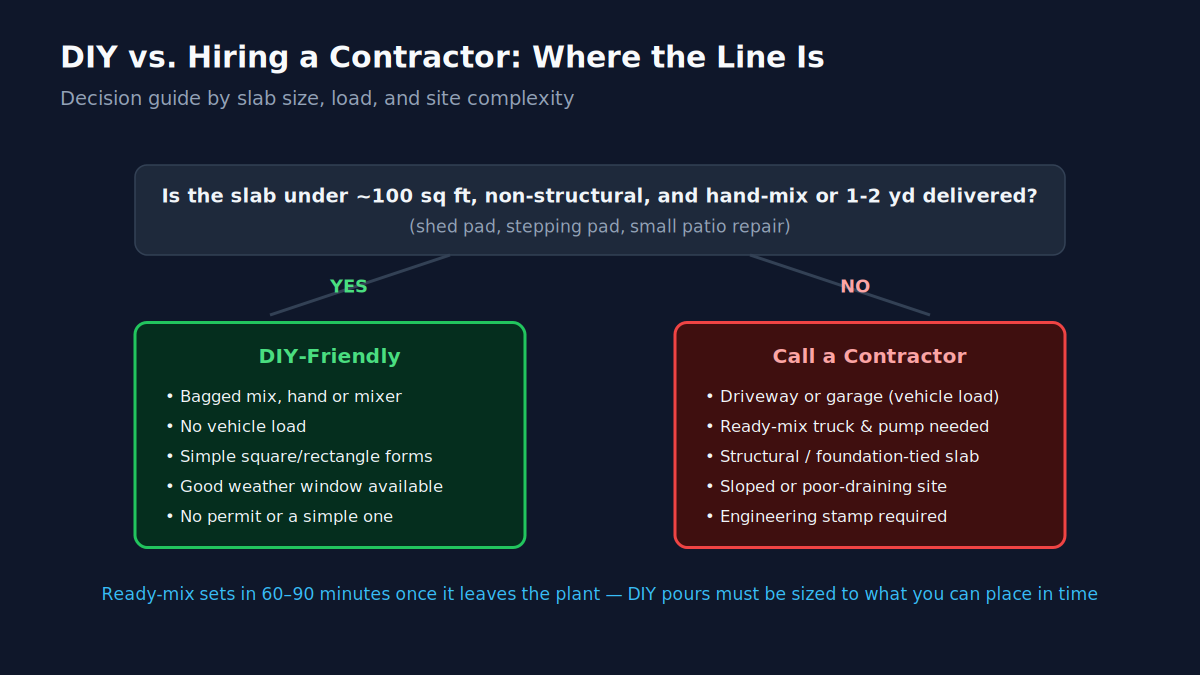
- Small, non-structural slabs — a shed pad, a stepping-stone pad, a small patio repair — typically under about 100 square feet, where bagged concrete mixed by hand or with a rented mixer is a manageable quantity. Our bags calculator will tell you exactly how many bags a project this size needs.
- Fence post and mailbox footings — small volumes, simple round or square forms, and forgiving tolerances make this a genuinely reasonable first concrete project.
- Simple rectangular forms where you can control the whole pour timeline yourself without racing against a large ready-mix truck’s schedule.
- Projects with a wide weather window, where you’re not forced to pour on a marginal-temperature day just to hit a deadline.
Where It Gets Genuinely Risky
- Anything carrying vehicle load — a driveway or garage floor needs correct thickness, reinforcement, and base preparation to handle that load without premature cracking, and the margin for a DIY mistake is much smaller than on a patio.
- Large pours needing ready-mix delivery. Ready-mix concrete sets in roughly 60 to 90 minutes once it leaves the plant, which means a DIY crew needs to be able to place, screed, and begin finishing an entire truckload before it starts hardening — a serious logistical and physical challenge for an inexperienced crew working alone.
- Anything structurally tied to your house — a foundation slab, an attached covered patio, anything an engineer would need to sign off on — where a mistake isn’t just cosmetic but a real structural liability.
- Sloped or poor-draining sites that need real grading and drainage expertise to get right, where a mistake creates a lasting water-management problem rather than just a rough-looking slab.
- Anything requiring a permit and inspection where you’d be personally responsible for meeting code, not just producing a slab that looks acceptable. See our permit guide for what that responsibility actually involves.
The Real Cost of a Failed DIY Pour
This is the part that doesn’t get talked about enough: a botched DIY concrete pour usually isn’t cheaply fixable. Once concrete has set, correcting a mistake — wrong thickness, missing reinforcement, a poor finish, a structurally inadequate base — typically means breaking it out and starting over, which costs more than if you’d hired a professional from the start. Compare the labor savings estimated by our labor cost calculator against the realistic risk of a redo before committing to DIY on a larger or higher-stakes project; the math doesn’t always favor DIY once you weigh in the failure risk honestly.
A More Useful Question Than “Can I DIY This”
Rather than asking whether you’re physically capable of pouring concrete — most people are, at least for a small volume — ask whether you can complete the entire pour-to-finish sequence within concrete’s working time, whether a mistake on this particular project is cheap or expensive to fix, and whether the project needs specialized equipment (a concrete pump, a power trowel, a plate compactor) you don’t have easy access to. A small, forgiving, low-consequence project passes all three tests easily. A driveway, a garage floor, or anything structural usually fails at least one.
A Middle Ground: DIY the Prep, Hire the Pour
One underused option: do the site preparation yourself — excavation, grading, compaction, forms, gravel base, following our yard prep checklist — and hire a professional crew for the actual pour and finish work, which is the step with the least forgiving time pressure and the most finish-quality skill involved. This can meaningfully reduce labor cost versus a fully turnkey contractor job while keeping the highest-risk step, the pour itself, in experienced hands.
Getting Help Without Hiring a Full Contractor
There’s a real middle ground between fully DIY and a fully turnkey contractor job that’s worth considering: hiring a couple of experienced day laborers just for the pour and finish window, while you handle the planning, material ordering, and site prep yourself. This gives you experienced hands for the truly time-critical, skill-dependent part of the job — placing and finishing concrete within its working time — without paying full contractor markup on the entire project. It works best for a mid-sized project (a patio or walkway, not a driveway) where you’re comfortable directing the work but want more hands and more finishing experience than you have on your own.
What Tools and Skills DIY Concrete Actually Requires
Beyond mixing and pouring, a decent DIY concrete result depends on skills that take some practice: screeding (striking off excess concrete level with the forms), floating (working the surface to bring cement paste up and embed larger aggregate), and finishing (broom texture, edging, and control joint tooling) all affect the final look and durability, and none of them are intuitive on a first attempt. If you’ve never finished concrete before, practicing on a small, low-visibility slab (like a shed pad) before attempting a more visible project (like a front walkway) is a reasonable way to build the skill without a costly first mistake being on display.
Insurance, Liability, and Resale Disclosure
A few practical consequences of DIY work that are easy to overlook until they matter: homeowner’s insurance can sometimes complicate a claim tied to unpermitted or owner-performed structural work, and if you sell the home later, some states require disclosure of significant DIY construction work, permitted or not. None of this means DIY work is prohibited or automatically problematic — plenty of homeowners successfully DIY concrete projects every year — but it’s worth factoring into the decision for anything beyond a small, low-consequence pour, particularly if you’re within a few years of a planned home sale.
Renting Equipment vs. Buying
For a one-time project, renting is almost always the better call over buying: a plate compactor, a concrete mixer, bull floats, and edging tools are all readily available at daily rental rates that are a small fraction of purchase cost. The one exception is basic hand tools (a margin trowel, a wood float, a screed board) which are inexpensive enough to buy outright and will get reused on future small projects. Book rental equipment in advance for your planned pour date — compactors and mixers are in high demand on weekends during peak construction season, and showing up without a reservation is a common way a DIY schedule falls apart at the last minute.
Weather and Timing Add Another Layer of Risk for DIY
Professional crews plan around weather thresholds as a matter of routine, but a first-time DIYer is more likely to push forward on a marginal-temperature day simply because the schedule (a rented mixer, a weekend off work, a delivery slot) is harder to reschedule. Building real flexibility into your DIY project timeline — rather than locking in a single date regardless of forecast — removes one of the more common causes of a disappointing first DIY pour.
Building Confidence Before You Commit to a Larger Project
If you’re new to concrete work and eyeing a larger DIY project down the road, there’s no substitute for practicing on something small and low-stakes first — a stepping-stone pad, a fence post footing, a small planter base. Get a feel for how quickly bagged concrete sets up, how it behaves when screeding and floating, and how your finish actually turns out, before you’re committed to a larger volume with less room to recover from a mistake. Most people who’ve successfully DIY’d a driveway or larger slab didn’t start there; they built up through a few smaller projects first.
Frequently Asked Questions
Is it cheaper to DIY a concrete slab than hire a contractor?
For material cost alone, yes, often significantly — you’re saving the labor markup. Factor in tool rental, your own time, and the real risk of a costly redo if something goes wrong, and the gap narrows meaningfully, especially on larger or higher-stakes projects.
Can I rent a concrete mixer instead of using ready-mix delivery?
Yes, for smaller volumes — a rented mixer works fine for bagged-concrete projects under a couple of cubic yards. Beyond that, mixing by hand or with a small mixer becomes impractically slow relative to concrete’s working time, and ready-mix delivery becomes the more practical (and often more cost-effective) option.
What’s the single biggest mistake first-time DIY concrete pourers make?
Underestimating how fast concrete becomes unworkable, especially with ready-mix delivery. Having a clear plan, adequate help, and all tools and forms genuinely ready before the truck arrives is more important than any individual finishing technique.
How many people do I need to pour a mid-sized DIY slab?
For a patio-sized pour (200–400 square feet) with ready-mix delivery, plan on at least three to four people — one managing the chute or wheelbarrow route, and two or more spreading, screeding, and finishing simultaneously. Trying to handle a pour that size solo is a common reason DIY finishes come out rougher than expected.
Calculate Your Concrete Project Budget
Use our comprehensive concrete slab cost calculator to get a complete line-item breakdown of materials, labor, reinforcement, and base preparation.
Launch Concrete Slab Calculator →