
Concrete Curing Time: How Long Before You Can Use It
Most people ask “how long does concrete take to dry” when what they actually need to know is how long it takes to cure — and those are two different clocks. A slab can look bone-dry on the surface within a day and still be dangerously weak underneath. If you’re planning to walk on a new patio, park a car on a fresh driveway, or set fence posts in a footing, the curing timeline below is the one that actually matters.
Curing vs. Drying: Why the Distinction Matters
Drying is just water evaporating off the surface. Curing is a chemical reaction called hydration, where cement and water react to form the crystalline structure that gives concrete its strength. Concrete that dries out too fast — on a hot, windy day, for example — can look finished while hydration has barely started underneath. That’s exactly how surface crazing and plastic shrinkage cracks happen, and it’s why contractors keep a slab damp for days after it looks perfectly dry.
The Concrete Strength Timeline, Day by Day
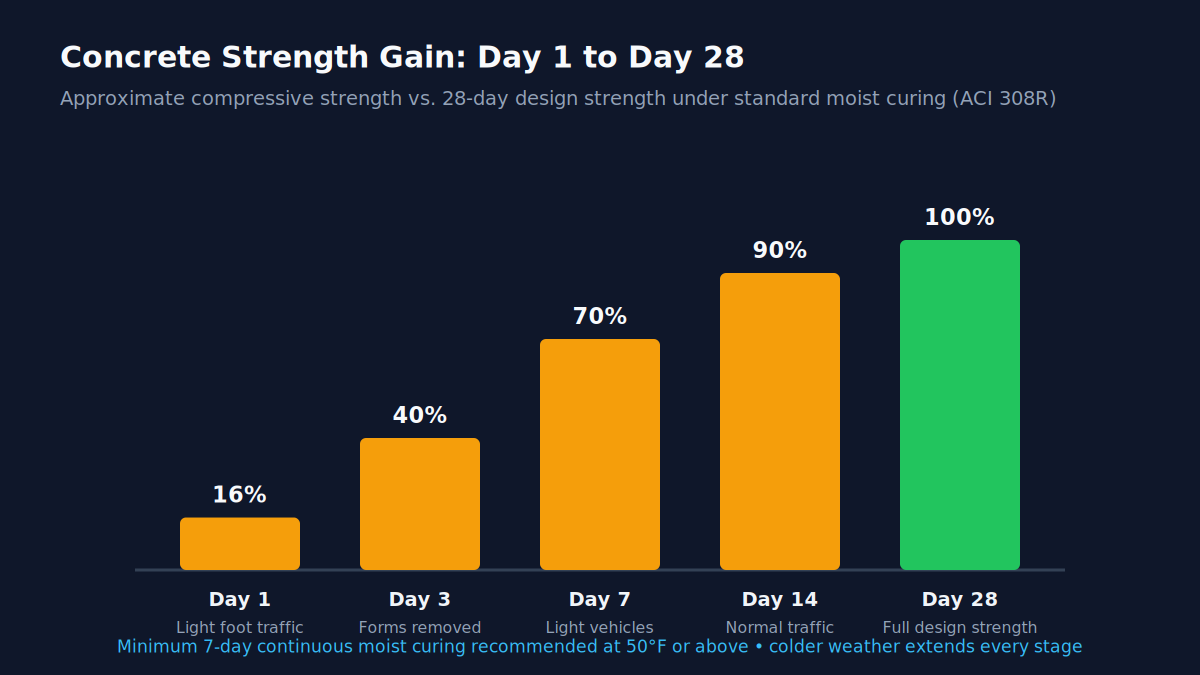
Concrete gains strength on a curve, not a straight line — it builds fast in the first week and then keeps improving slowly for years. For planning purposes, though, these are the milestones that matter:
| Time Since Pour | Approx. % of Design Strength | What’s Safe |
|---|---|---|
| 24–48 hours | ~16% | Careful, light foot traffic only |
| 3 days | ~40% | Normal foot traffic; non-structural forms can come off |
| 7 days | ~65–75% | Light vehicles (your own car, gently) |
| 14 days | ~90% | Normal vehicle traffic; most formwork removed |
| 28 days | 100% (design strength) | Full structural load, heavy vehicles, sealing |
The “28-day strength” you see quoted on every bag of concrete and every ready-mix ticket isn’t a hard ceiling — it’s the age at which standard test cylinders are broken to confirm the mix hit its specified PSI. Concrete keeps gaining a small amount of strength for months and years afterward as long as any residual moisture is present, but 28 days is the industry’s practical benchmark for “fully cured” and it’s why we use it as the finish line on this site’s own concrete slab cost calculator assumptions.
The 7-Day Rule: Why Contractors Won’t Shut Up About It
If you take away one number from this article, make it seven. ACI 308R — the American Concrete Institute’s guide to curing — calls for a minimum of 7 days of continuous moist curing at 50°F or above for a standard mix using ordinary Type I or II cement. That means keeping the surface wet (or covered with a curing compound or plastic sheeting) so hydration doesn’t stall out from evaporation. Skip this step on a hot, sunny week and you can lose a meaningful chunk of long-term durability even though the slab “looks” fine.
Higher-strength mixes, slower-hydrating cement blends, or anything poured in cold weather may need a longer curing window. If you’re using an accelerated-set or high-early-strength mix for a fast turnaround project, ask your supplier for the specific curing schedule — don’t assume the standard 7-day number applies.
Temperature Changes Everything
All of the timeline numbers above assume a moderate temperature, roughly 70°F. Concrete chemistry is temperature-sensitive in both directions:
- Cold weather (below 40°F): Hydration slows dramatically and can stop almost entirely if the concrete freezes before it reaches about 500 psi. ACI 306 classifies anything at or expected to fall below 40°F as cold-weather concreting, which requires protection — insulating blankets, heated enclosures, or temporary heat — until the mix is strong enough to resist freeze damage, typically within 48 hours at 50°F.
- Hot weather (above ~85°F): Water evaporates faster than it can be replaced by bleed water rising to the surface, which is the classic recipe for plastic shrinkage cracking. ACI 305 hot-weather guidance caps concrete discharge temperature at 95°F and recommends early-morning pours, fogging, and evaporation retardants once conditions get aggressive.
If your timing is flexible, see our guide on the best time of year to pour concrete for how seasonal temperature swings affect scheduling in most U.S. climates.
How Curing Method Affects the Timeline
You can’t control the weather, but you can control how you cure. Four common methods, roughly ranked from most to least effective for a DIY pour:
- Wet curing (ponding, soaker hoses, or damp burlap): Keeps the surface continuously saturated. Most effective, but labor-intensive since it needs re-wetting multiple times a day.
- Plastic sheeting: Traps the concrete’s own moisture underneath. Cheap and effective, but watch for uneven color/sheen (blotching) if the sheeting touches the surface unevenly.
- Liquid curing compound: Sprayed on immediately after finishing; forms a membrane that slows evaporation. What most professional crews use because it’s fast and doesn’t need re-application.
- Doing nothing: Not a real curing method, but worth naming because it’s the default if you walk away after finishing. In dry, windy, or hot conditions this is how surface durability problems start.
When Can You Actually Do Things on It?
Translating the strength curve into real project decisions:
Practical Wait Times
Walking on it: 24–48 hours for careful foot traffic; 3 days for normal use.
Setting up furniture, a grill, or a basketball hoop base: Wait the full 7 days if the item is heavy or has a small footprint that concentrates load.
Driving a car on it: 7 days minimum, and only if the mix was a standard 3,000+ PSI residential design. Give it the full 28 days before you park a heavy vehicle like an RV or box truck.
Building a structure on it (shed, garage framing): Most contractors wait the full 28 days before loading a slab with a permanent structure, especially if it’s carrying point loads from posts or walls.
Sealing or staining it: Wait 28 full days. Sealing too early traps residual moisture underneath the sealer, which can cause cloudiness, bubbling, or delamination. See our guide to concrete sealers for the full timing and product breakdown.
Why This Matters for Your Budget, Not Just Your Patience
Rushing the cure isn’t just a durability risk — it’s a financial one. A driveway loaded with a heavy vehicle before it’s cured can develop surface spalling or cracking that’s expensive to fix later, and a slab that never got proper moisture curing tends to show more shrinkage cracking over its life, which shortens the interval before you’re looking at resurfacing or repair. If you’re estimating a new pour, our concrete slab cost calculator already assumes standard curing practices went into the pricing data behind it — skipping curing steps to “save time” doesn’t actually save money once you account for the repair bill down the line.
Common Curing Mistakes That Cost People Money
Most of the curing problems we hear about trace back to one of a handful of avoidable mistakes:
- Removing forms too early. Non-structural side forms can usually come off around day 3, but anything supporting a load — like formwork under a step or ledge — needs to wait until the concrete can actually carry that weight itself.
- Sealing before 28 days. This is probably the single most common DIY mistake. Sealer applied over concrete that hasn’t finished curing traps moisture vapor underneath the membrane, which shows up later as cloudy white haze, bubbling, or the sealer peeling off in sheets.
- Assuming “dry to the touch” means “cured.” A slab can feel completely dry within 24 hours in hot, windy weather while the interior hydration process is still only a fraction complete. Judge readiness by elapsed time and temperature, not by touch.
- Skipping curing entirely on a “quick” DIY project. Small pours — a fence post footing, a stepping pad — are exactly the projects most likely to get zero curing attention, and while they’re less likely to fail catastrophically, they’ll show more surface dusting and a shorter service life than a properly cured pour.
Indoor Slabs vs. Outdoor Slabs
An indoor slab (basement floor, garage floor under a finished building) cures in a more controlled environment — no direct sun, no wind, often more consistent temperature — which generally makes the process more forgiving. The tradeoff is ventilation: indoor slabs can take noticeably longer to fully dry out (as opposed to cure) if the space is closed up and humid, which matters if you’re planning to install flooring on top. Most flooring manufacturers want a slab to reach a specific moisture emission rate, tested with a calcium chloride test or in-situ probe, before laying down vinyl, hardwood, or epoxy coatings — that can take 30, 60, or even 90+ days depending on slab thickness and ambient humidity, well beyond the 28-day structural cure.
Curing a Repair Patch vs. a Full New Slab
Small repair patches and thin overlays cure faster in absolute time because there’s less mass and less depth for moisture to travel through, but they’re also more vulnerable to fast drying because a thin section has proportionally more surface area exposed to air relative to its volume. If you’re patching rather than pouring new, treat the curing schedule as equally important — arguably more so, since a rushed patch is one of the most common reasons a repair fails to bond and pops back out within a season. Our guide to resurfacing an existing slab covers overlay-specific curing considerations.
Frequently Asked Questions
Can I speed up concrete curing?
Not the chemistry itself, but you can avoid slowing it down. Keeping the slab warm (above 50°F) and consistently moist for the first week lets hydration proceed at its natural pace instead of stalling from cold or drying out from evaporation. Accelerating admixtures exist for time-critical jobs, but they change the mix design and aren’t a simple additive for a DIY pour.
Does rain right after pouring ruin the concrete?
Light rain after the surface has set (a few hours in) usually isn’t a problem and can even help curing. Heavy rain in the first hour or two, before the surface has firmed up, can wash out cement paste and mar the finish — that’s why experienced crews watch the forecast closely on pour day.
Why does my new concrete look patchy or lighter in some spots?
Uneven curing is the most common cause — spots that dried faster (near an edge, under sun exposure) cure differently than shaded or damp areas. It’s usually cosmetic and fades over the following weeks as the whole slab equalizes in moisture content.
How long before I can put a rug or floor mat on a new garage slab?
Wait the full 28 days. Covering a slab with anything that traps moisture against the surface before it’s cured can leave a permanent damp patch or discoloration underneath.
Calculate Your Concrete Project Budget
Use our comprehensive concrete slab cost calculator to get a complete line-item breakdown of materials, labor, reinforcement, and base preparation.
Launch Concrete Slab Calculator →