
Best Time of Year to Pour Concrete (And What Happens If You Don’t Wait)
The short answer: spring and fall, when daytime temperatures sit comfortably between 50°F and 85°F, give you the widest margin for error with the least amount of extra effort. But “the best time” really means the widest gap between the temperature threshold that requires cold-weather precautions and the one that requires hot-weather precautions — and depending on where you live, that window might be wider or narrower than the calendar suggests.
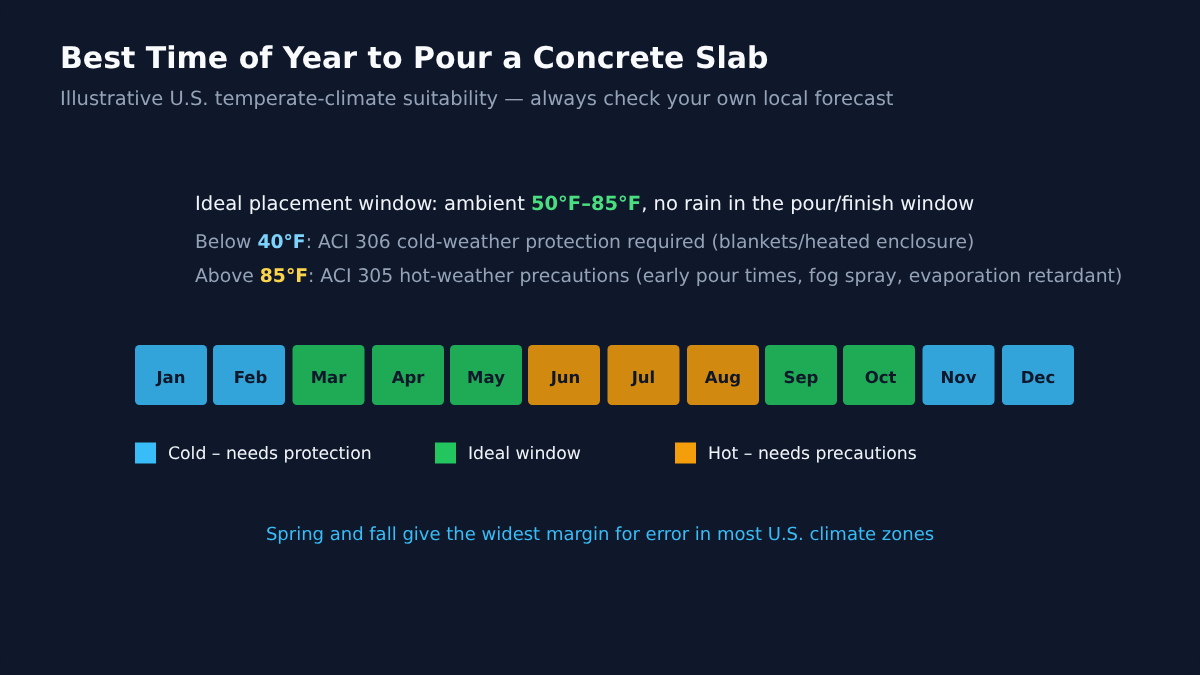
The Ideal Window: 50°F to 85°F
Concrete cures through a chemical reaction (hydration) that proceeds at a predictable rate in this range without needing special protection, extra water management, or schedule changes. No rain in the pour-and-finish window matters just as much as temperature — a downpour in the first hour or two after placing concrete, before the surface has firmed up, can wash out cement paste and ruin the finish.
Why Cold Weather Is a Real Constraint, Not Just an Inconvenience
ACI 306 defines cold-weather concreting as any period where air temperature has fallen to, or is expected to fall below, 40°F during the protection period. Below that threshold, hydration slows dramatically, and if the concrete freezes before it reaches roughly 500 psi — typically within about 48 hours at 50°F, but longer in colder conditions — the ice crystals that form inside the mix can permanently damage its structure. That damage doesn’t heal once the concrete thaws; it’s baked in.
If a cold-weather pour is unavoidable, the standard precautions are: using an accelerated-set mix, keeping the concrete’s own temperature elevated with heated mixing water or aggregate, and protecting the slab with insulating blankets or a heated enclosure for a minimum protection period (often 1 to 6 days depending on conditions and mix type). This isn’t optional guesswork — it’s a documented, testable requirement on any project where an inspector or engineer is involved, and it adds real cost and complexity to a DIY pour.
Why Hot Weather Isn’t Automatically Fine Either
The failure mode in hot weather is the opposite problem: water evaporates from the surface faster than bleed water can replace it, which is the textbook cause of plastic shrinkage cracking (see our guide to crack causes). ACI 305.1 caps the concrete’s own discharge temperature at 95°F for most general construction, and many contractors treat 85°F ambient air temperature as the practical point where extra precautions — pouring at dawn, fogging the surface, using an evaporation retardant, or adding set-retarding admixture — become worth the effort.
High wind makes hot-weather evaporation problems significantly worse even at moderate temperatures, so a hot, breezy afternoon can actually be a tougher pour than a hotter, still one.
A Realistic Seasonal Breakdown (U.S. Temperate Climates)
- Spring (March–May): Usually the sweet spot as temperatures climb out of the cold-weather zone, though watch for late-season frost warnings and spring rain, which can push back a pour date more than the temperature itself does.
- Summer (June–August): Workable almost everywhere, but plan around midday heat — early morning pours are standard practice once daytime highs regularly clear 85–90°F.
- Fall (September–November): Often the most forgiving stretch of the year — warm enough for easy curing, cool enough to avoid hot-weather precautions — until temperatures start dropping toward the cold-weather threshold late in the season.
- Winter (December–February): Technically possible with cold-weather protection in most climates, and unavoidable in far-northern regions with short building seasons, but it adds cost, complexity, and risk that’s worth avoiding if your schedule has any flexibility at all.
These bands are illustrative, not a substitute for checking your actual local forecast — a “spring” week in the upper Midwest and a “spring” week in the Gulf Coast are entirely different pour conditions.
Scheduling Around Curing, Not Just Pouring
It’s easy to focus entirely on pour-day weather and forget that the curing window that follows needs reasonable conditions too. A pour timed perfectly for a mild 65°F day followed by a week of unseasonable near-freezing nights still needs cold-weather protection during that curing period, even though the pour itself went smoothly. When you’re picking a date, look at the extended outlook for the following week, not just the 24 hours around the pour.
What If You Can’t Wait for Ideal Conditions?
Sometimes a project has a hard deadline — a closing date, a permit expiration, a contractor’s availability window — and you can’t simply wait for the calendar to cooperate. In that case:
- Talk to your ready-mix supplier about mix adjustments (accelerators for cold, retarders for heat) rather than trying to force a standard mix to perform outside its comfort range.
- Budget extra time and, if hiring out the work, expect a modest cost premium for cold- or hot-weather protection labor and materials.
- Extend the curing period rather than shortening it — concrete poured in marginal conditions benefits from longer, not shorter, protection and moist curing. See our full curing time guide for the standard timeline this extends from.
How This Affects Your Project Budget
Timing your pour for the ideal window isn’t just about convenience — it removes line items from your budget. Cold-weather protection (blankets, heaters, extended labor for monitoring) and hot-weather precautions (early-morning crew scheduling, evaporation retardants, more frequent finishing attention) both add real cost that a spring or fall pour in moderate conditions simply doesn’t need. If you’re comparing quotes, ask whether weather protection is already included or would be billed separately if conditions turn.
How Professional Crews Plan Around Weather
Experienced concrete contractors don’t just check tomorrow’s forecast — they watch a rolling multi-day outlook, because the risk window isn’t limited to the pour itself. Overnight lows for the first 48 hours matter just as much as the daytime pour temperature, since an unexpected cold snap the night after a pour can still cause freeze damage even if the pour day itself was mild. Crews working in shoulder seasons (late fall, early spring) often build in a buffer day or two of flexibility specifically because temperature swings are less predictable at the edges of the ideal window.
Regional Climate Zones Change the Calendar
The “spring and fall” rule of thumb assumes a temperate climate with four real seasons. In practice:
- Hot, arid regions (Southwest): The ideal window often shifts to late fall through early spring, avoiding the punishing summer heat entirely rather than working around it.
- Humid subtropical regions (Gulf Coast, Southeast): Summer heat combines with high humidity, which actually slows evaporation somewhat compared to hot, dry conditions, but afternoon thunderstorms become the bigger scheduling obstacle.
- Northern/continental climates: The cold-weather window can span 4 to 6 months of the year, which is why northern contractors do a disproportionate share of their annual concrete work in a compressed spring-through-fall season.
- Mild coastal climates: Some regions barely leave the 50–85°F range year-round, making the “best time of year” question almost moot.
Planning Backward From Your Deadline
If you have a fixed deadline — a home sale closing, an event, a permit expiration — work backward from that date and build in the full cure time, not just the pour date. Remember that even a rushed project still needs the structural portion of the curing timeline (7 days minimum for light use, ideally 28 for full load) after the pour itself, and add a few days of schedule buffer for weather delays, especially if you’re targeting the edges of the ideal season rather than the middle of it.
A Quick Pre-Pour Weather Checklist
- Confirm the forecast high and overnight low for the pour day and the following 2–3 days, not just the pour hour itself.
- If daytime temperatures are trending toward or below 40°F, plan for cold-weather protection materials (insulating blankets, heated enclosure) in advance rather than scrambling once the truck arrives.
- If temperatures are trending toward or above 85°F, schedule the pour for early morning and have fogging equipment or an evaporation retardant ready.
- Check for rain in the placement and finishing window specifically — a forecast showing rain later that night is a very different risk than rain predicted during the pour itself.
- Confirm your ready-mix supplier is aware of the conditions so they can adjust the mix (accelerator or retarder) rather than delivering a standard mix into marginal weather.
Frequently Asked Questions
Can concrete be poured in the rain?
Light rain after the surface has begun to set is usually manageable, but pouring into active rain, or getting hit by a downpour in the first hour, can wash out the surface and ruin the finish. Most crews will postpone a pour if rain is forecast during the placement and initial finishing window.
Does pouring in cold weather make the concrete weaker forever?
If it’s protected properly and not allowed to freeze before reaching adequate early strength, no — it will reach full design strength, just more slowly. If it does freeze too early, the damage is permanent and doesn’t reverse once temperatures warm up.
What’s the single easiest month to pour concrete in most of the U.S.?
There’s no universal answer since climates vary so much, but late spring (May) and early fall (September–October) tend to hit the 50–85°F window most reliably across the widest range of U.S. regions.
Does humidity matter as much as temperature?
Yes, especially in hot weather — low humidity combined with wind and heat dramatically raises the evaporation rate, which is the real driver behind plastic shrinkage cracking, more so than temperature alone.
Calculate Your Concrete Project Budget
Use our comprehensive concrete slab cost calculator to get a complete line-item breakdown of materials, labor, reinforcement, and base preparation.
Launch Concrete Slab Calculator →